Ophthalmology
Red, watery or cloudy eyes need to be checked soon — at every filu practice.
How do you know your pet's eye needs help?
Eyes are the organ where waiting costs the most. What looks like a mild irritation on Monday can be a deep corneal defect by Wednesday. And animals show eye pain differently than we do: they squint, rub, seek out dark places or simply go quiet. Let us take a look if you notice any of these: The eye is watery, red or squeezed shut. Your pet paws at it or rubs its head along the floor. The cornea looks cloudy, milky or bluish. The pupils are different sizes. Your pet bumps into things in a familiar place or becomes unsure in the dark. And one thing that matters to us: please don't use eye drops from the medicine cabinet or left over from last time. Some active ingredients make a corneal defect much worse instead of healing it.
Our ophthalmology services
Eye check and initial diagnostics
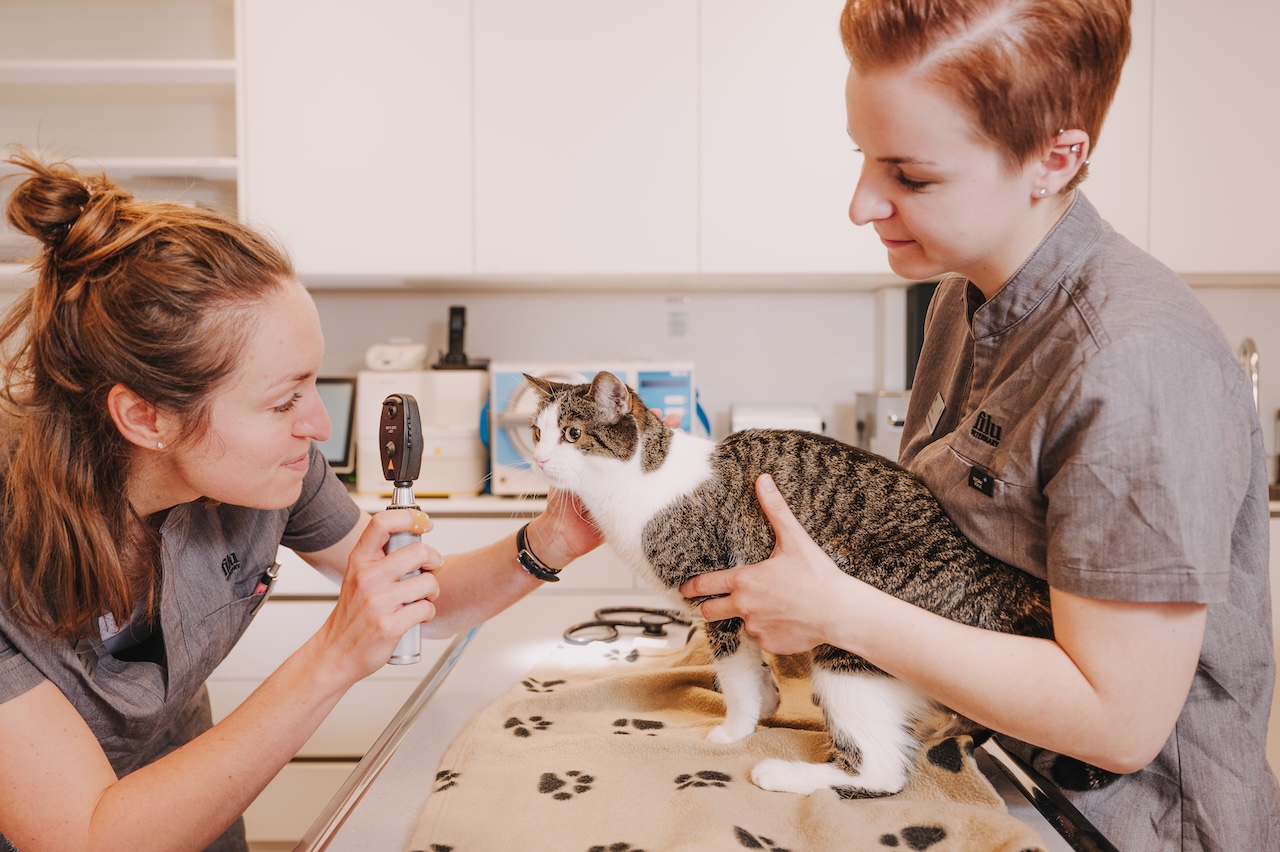
Every eye examination starts the same way: we look closely at the eye, check tear production and stain the cornea to make defects visible. That tells us whether we are dealing with an irritation, an inflammation or an emergency. You get this basic examination at every filu practice.
At some locations (München Schwabing, München Wiener Platz, Hannover, Düsseldorf) we also use a slit lamp as part of the eye examination. It is one of the most important examination devices: with 10 to 16 times magnification, small changes can be assessed more precisely and shifts in individual structures can be detected (e.g. lens luxation) — important when a finding remains unclear.
Eye emergencies
Some things can't wait. Call us right away if your pet suddenly can't see, an eye bulges out, there is a visible injury, or your pet squeezes an eye shut and is clearly in pain. A hard, red eye with a dilated pupil also needs to be seen immediately — it can be a sign of a sudden rise in pressure. The pressure has to be lowered within 24 to 48 hours for the eyesight to have a chance.
Conjunctivitis, corneal and eyelid margin inflammation
The red, watery eye is the most common reason animals come to us with eye problems. Behind it is usually conjunctivitis — less often a foreign body, a corneal defect or a misaligned eyelid that rubs constantly. Because treatment is completely different depending on the cause, we find out what it is first and then treat. Dropping something in on a hunch doesn't help.
Dry eye
When an eye produces too little tear fluid, the cornea loses its protective film. Typical signs are sticky mucus in the corner of the eye, recurring inflammation and a dull cornea. A simple test that measures tear volume can confirm it. Treatment is always lifelong — but it keeps the eye nicely stable.
Glaucoma
In glaucoma, the pressure in the eye rises. It is painful, even if you often can't tell by looking at your pet — many just become quieter and withdraw. If glaucoma is suspected, and in animals at higher risk because of their breed or a previous condition, the intraocular pressure must be measured. That is done with a tonometer, and not every one of our practices has one. So please call ahead, and we will tell you where you can get answers quickly. The sooner the pressure is lowered, the better the prognosis for preserving eyesight.
Cataracts and lens opacity
When the lens clouds over, the eye looks milky and your pet sees less well. Not every opacity is a cataract — in older animals the lens also changes with age without affecting vision much. We tell the two apart, look into possible causes (e.g. diabetes mellitus) and discuss with you whether surgery makes sense. Cataract surgery is done by eye departments set up for it — we prepare the case and refer you on.
How an eye examination works with us
First we ask when you noticed changes, which eye is affected, what has changed and what previous conditions there are. You know your pet best, and most of what puts us on the right track comes from you.
Then we look at both eyes, including the unaffected one — for comparison. We check the reaction to light, measure tear production and stain the cornea to make defects visible. Where a tonometer is available, we also measure the intraocular pressure. It doesn't hurt, and most animals hold still well.
At the end we talk through what we found and what follows from it — and whether a follow-up is needed to monitor progress.
Advanced training in ophthalmology
Examining, diagnosing and treating eyes is part of basic care at filu — you get it at every one of our practices.
At some locations, vets work with an additional qualification in ophthalmology (GPCert Ophthalmology). If a finding is more complicated or you want a second opinion, these are the practices that can help. You can see which ones on the location pages — each team lists its areas of focus.
My dog has a red eye — can it wait until tomorrow?
It depends on how he is doing. If you notice anything unusual about the eye, always get in touch with us. On the phone we ask a few questions and work out with you how urgent it is — depending on appointment availability, you come right away or in a few hours. If he squeezes the eye shut, rubs it or seems down, tell us straight away on the phone: pain in the eye is always a reason to be quicker.
Can I give eye drops from my medicine cabinet?
Please don't. What helps with conjunctivitis can harm a corneal defect. Without knowing what is wrong with the eye, dropping something in is a risk.
My pet is blind in one eye — is an examination still worthwhile?
Yes. First, because we can find out whether the other eye is at risk. Second, because a blind eye can continue to hurt — in that case we recommend removing the eye (enucleation).
Do you also operate on eyes?
On the eyelid and eyelid margin, yes, at some locations (München Schwabing, Hannover). We don't perform cataract surgery ourselves — for that we work with eye departments that are set up for it.
Does my pet need anesthesia for the examination?
Usually not. The basic examination is done on the awake animal. Only if we need to look deeper or the eye is too painful do we sedate.
